
Is hiking the Inca Trail to Machu Picchu on your bucket, but you don’t know where to start? You’ve come to the right place!
In this article I have outlined everything you need to know about hiking the Inca Trail to Machu Picchu, in Peru. Including what to pack, how to book it, how to prepare, day-by-day breakdowns of what the hike is like, and much more.
Machu Picchu was the final Wonder of the World I still hadn’t seen, and it had been on my bucket list for years. I wanted to do something special to mark this incredible place off my bucket list.
When I found out about the Inca Trail, I knew that was it. To accomplish it I teamed up with G Adventures, and it really was one of the most incredible things I’ve ever done.
Photos and videos of Machu Picchu don’t do it justice. Hiking for four days on an ancient route, built by the Incas over 500 years ago, and finally arriving at one of the Wonders of the World, is a once in a lifetime experience.
Looking at the ancient citadel, surrounded by mountain peaks and sweeping valleys will leave you breathless. So what are you waiting for? Read on, and discover everything you need to know about hiking the Inca Trail!
Contents
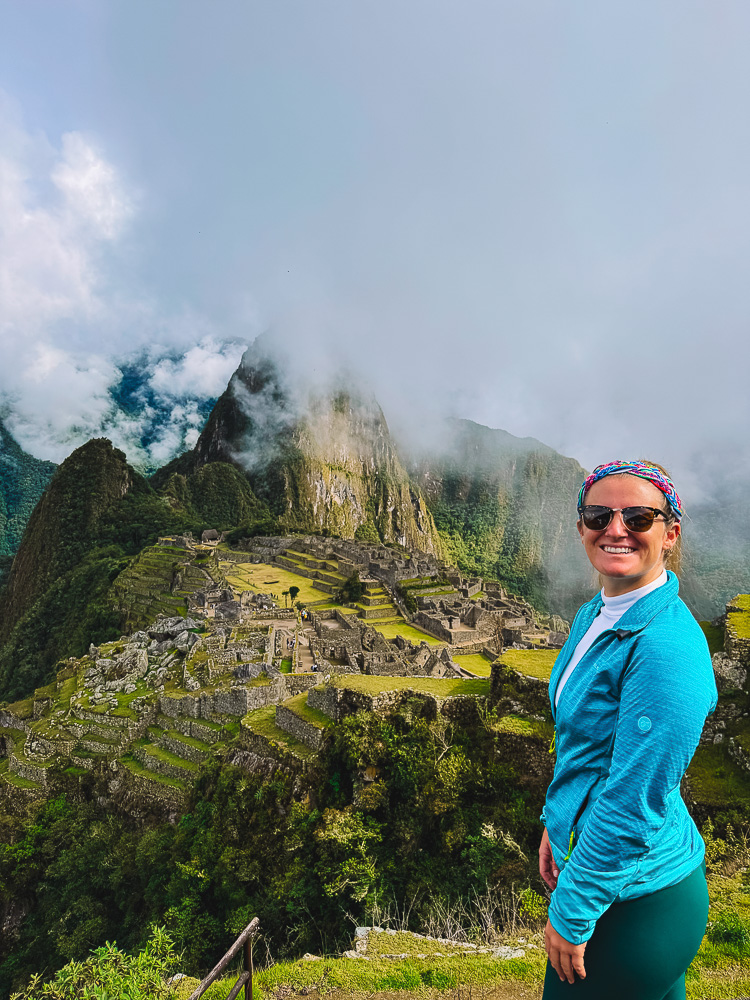

Enjoying the view over Machu Picchu in Peru
What is the Inca Trail?
The classic Inca Trail is a 42km hiking trail that takes you from its starting point at KM 82, about 45 minutes drive from Ollantaytambo, all the way to Machu Picchu.
It’s part of a wider network of walking trails that once used to connected the Incan Empire (which back in the day was formed by parts of Peru, Ecuador, Bolivia, Argentina and Chile), and dates back to the 15th century.
There are countless hiking trails in the Peruvian Andes that you could do, but this specific 4-day 3-night hike is the “classic” Inca Trail. It’s the most famous and popular hiking route that you can take to Machu Picchu.
It’s the one we hiked, and which I’ll be talking about in this blog post.
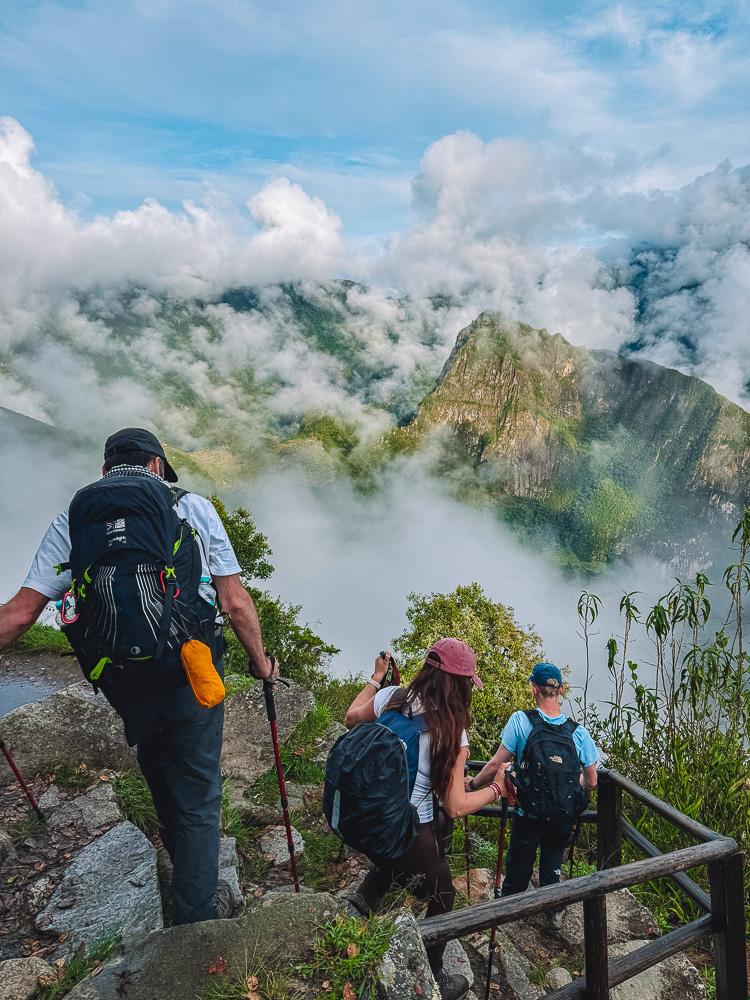

Hiking the final section of the Inca Trail from the Sun Gate to Machu Picchu
How to book your Inca Trail hike
You’re not allowed to just go and hike the Inca Trail on your own. You have to do it with a licensed tour operator, which will look after all the logistics and permits for you.
About the Inca Trail permits
The Inca Trail is highly regulated by the Peruvian government, and is restricted to 500 people per day. This is for both trekkers and the support crew of porters, guides and chefs.
Getting a permit can be tricky as they sell out well in advance, and are both non-transferable and non-refundable. When you book with a licensed tour operator, like G Adventures, they will take care of the permits for you.
However, you should still book well in advance, even with a tour operator, as permits can sell out very quickly, especially in high season.


Admiring some of the ancient ruins on the Inca Trail in Peru
Choosing the right Inca Trail tour operator
There are a variety of companies that do the Inca Trail, but choosing the right one will make all the difference, both for your experience and for the local team supporting you.
Without the porters, chefs and guides, it simply wouldn’t be possible to hike the Inca Trail. They have an incredibly tough job, carrying everyone’s bags, tents and gear, as well as ensuring you have a great time.
Which is why, when we were choosing who to hike the Inca Trail with, we wanted to ensure we did it with an ethical company, who treats its porters well, and who supports local communities.
That’s why we chose G Adventures, and joined their Inca Discovery Plus Tour.
G Adventures has been nominated the Best Inca Trail Tour Operator by the Regional Direction of Foreign Trade and Tourism of Cusco (RDFTTC).
Click here to find out more about the Inca Discovery Plus Tour by G Adventures!


Our G Adventures Inca Trail crew! Including trekkers, porters, chefs and guides


The G Adventures porters hiking the Inca Trail


Our campsite on the second night of the Inca Trail
They ensure that porters and guides are paid a fair wage, and they follow strict rules to guarantee them good working conditions. For example, the G Adventures porters have a strict 20kg limit on the bags they carry, as well as rest days scheduled between trips.
Not all tour operators do this, and they’ll overload their porters so they can get less porters and reduce expenses.
Besides their treatment of the porters, G Adventures as a company has a big focus on community tourism. They support local communities, and ensure that the money that travellers spend, actually reaches the people on the ground.
It’s also a great company for group trips in general. It’s very international, with travellers joining from all over the world, which makes it very fun and interesting.
Especially for a trip like this one, where you’re spending days in close contact hiking and camping, it’s a great opportunity to get to know your fellow travellers well, celebrating the exciting moments of the trail, and together embracing the mishaps, like the occasional moments of bad weather.


Enjoying the stunning mountain views along the Inca Trail
What to pack for the Inca Trail
Packing for the Inca Trail can feel a bit daunting, especially given the weight limit, but it doesn’t have to be complicated. It actually makes you realise how little you need when you have a strict weight limit.
As previously mentioned, G Adventures is super strict on how much weight the porters have to carry. To ensure they don’t go over, every hiker is provided with a black duffel bag for their belongings, which will be given to the porters to carry.
This bag can’t go over 6kg each. Bear in mind that this duffel bag also has to fit your sleeping bag and sleeping mattress.
If you have your own, and it’s a fancy super lightweight one, I’d recommend bringing it to Peru, as it will give you some extra weight allowance for your clothes and other stuff.
Alternatively, you can rent them from G Adventures, just bear in mind that the sleeping mattress and sleeping bag that G Adventures provides weigh 3.5kg, so you only have 2.5kg left for your belongings.


Enjoying our first glimpse of Machu Picchu from the Sun Gate
In my duffel bag I packed:
- 3 sports / thermal shirts
- 1 heavy hoodie for the night
- 4 pairs of socks
- 3 pairs of underwear
- 1 extra leggings
- Toiletries bag
- Flip-flops
- 1 pijama
And this fitted perfectly in the allotted 2.5kg weight I had left.
In this black duffel bag you should pack the clothes you plan on changing into over the four days, but nothing that you might need during the day, as the porters will be carrying this bag, and you will only have access to it at the end of the day at the campsite.


Machu Picchu in Peru, one of the Seven Wonders of the New World


Some of the gorgeous views we saw while hiking the Inca Trail in Peru
Besides that, in my day backpack I was carrying:
- Waterproof coat
- Waterproof trousers
- Extra down jacket
- Extra hoodie (I ended up using this one in evenings, but not during the day, as you get warm while hiking)
- Extra gilet (I didn’t end up using this one as it was never cold enough)
- My camera & other electronics
- 2 water bottles (1.5L in total)
- Various snacks
- Toilet paper & baby wipes
- 2 hats (one bucket hat for sun protection, one fluffy hat for the cold)


Hiking up to Dead Woman’s Pass in Peru
Basically depending on the time of day and weather, my backpack was either empty and super light (when it rained and I happened to be wearing more layers, or had drunk all my water), or pretty full and quite heavy (when it was sunny and warm, and I removed all my layers).
It can seem inconvenient, but carrying all the extra layers in your day bag is the only way to ensure you are prepared for every change of the weather.
Besides the above lists, I also packed waterproof hiking shoes and hiking poles. If you don’t have your own hiking poles, you can rent them from G Adventures before the trip starts.


Enjoying the sunshine during our Inca Trail hike
Best time to hike the Inca Trail
Besides February, when the Inca Trail is closed due to strong rainfall and for maintenance works, you could potentially hike the Inca Trail at any time of the year.
That said, the dry season, from May to October is generally considered the best time to hike the Inca Trail, as you have the least chance of rain, and the highest chance of getting a clear Machu Picchu view, without clouds covering it up.
However, this is also the high season, which means the trail and campsites will be much busier, and the temperatures at night will be considerably colder.
During the rainy season, from November to April, the trail will be less busy and prices will be cheaper, but as the name suggests, you run the risk of hiking and camping under constant rain.


Befriending some llamas while hiking the Inca Trail
Plus, it could also be cloudy when you get to Machu Picchu, which means you won’t be able to see the iconic view we’re all dreaming of.
We did the Inca Trail in early December, and I was pretty scared of hiking in the rain or not being able to see Machu Picchu.
However our fabulous guides told us that even in rainy season the weather can be super unpredictable, and not to worry too much.
We ended up getting super lucky with the weather, and despite the occasional foggy moment and one night of rain, we always had amazing sunny weather and clear skies.

Hiking down from Dead Woman’s Pass – one of the foggier / rainier days of our Inca Trail hike
Preparing for the Inca Trail
Besides the packing and logistics of the trip, the two main aspect that people struggle with and that you have to prepare for, are fitness and altitude sickness.
Fitness
The Inca Trail is a hard hike, there is no denying it. That said, it’s also broken up in a way to make it easier to accomplish, and you’ll have all the support you need to do so.
There are lots of rest stops along the way, and your guide will support you throughout the whole hike.
Also, it’s not a competition, you don’t have to race through it, if you feel like you need a break you can just take it, you don’t have to wait to get to a rest stop.
Our group had two guides, one which led the group from the front, and one that stayed at the back with the slowest hikers. In our group, that was us.

Some of the Inca ruins we saw during our Inca trail hike

Some of the Inca ruins we saw during our Inca trail hike
I like to say it’s because we stopped frequently for photos and videos, but the reality was that we needed the breaks.
This isn’t to say that you can just rock up with no training, I just want to reassure you that if you’re a reasonably fit person, you’ll most likely be fine.
If you can, just try to train a bit in the lead up to the trip, working on things like your endurance (running, cycling etc) and getting some practice hiking in the mountains with poles if you’ve never done it.
I didn’t specifically train for the Inca Trail, but I’m a fairly fit person who did a triathlon a couple months before the Inca Trail, and I try to go on a hike at least once a week. I found the Inca Trail to be very hard, but doable.

Enjoying the view over Machu Picchu after four days of hiking!
Altitude sickness
Altitude sickness is sneaky, and it can affect you regardless of how fit you are. During the Inca Trail you go from the 2,400m of Machu Picchu, all the way to 4,200m at Dead Woman’s Pass.
To avoid altitude sickness I suggest you give yourself some time to acclimatise, spending at least two nights at altitude in Cusco and/or Ollantaytambo, like we did on the Inca Discovery Plus Tour.
This gives your body some time to acclimatise at altitude when it’s not under physical stress, doing normal things like eating and sleeping.
We bought tablets for altitude sickness, but found we didn’t really need them. I only took them twice during the four days, when I felt a slight headache and to avoid it getting worst.
We also drank loads of coca tea at every meal, and had some coca candy during the day.

Hiking the Inca Trail to Machu Picchu in Peru

Mountain views from the top of Dead Woman’s Pass
Logistics of hiking the Inca Trail
The campsites & sleeping arrangements
Unless it wasn’t already clear, let me reiterate that there are no hotels, guest houses, hostels or anything of the sort on the Inca Trail. If you want to do the epic 4-day hike to Machu Picchu, you will have to sleep in a tent.
G Adventures provides the tents and a basic sleeping mat, but you will have to rent the sleeping bag and proper sleeping mattress (unless you bring your own from home).
On the shared group tours, you will usually be sharing a tent with one other traveller.
The porters will set up your tents at designated campsites, which are strictly regulated by the Peruvian government. You can’t just set up camp anywhere you want on the trail.
I found the campsites to be pretty spacious, relatively clean and well organised.

Our campsite on the first night of the Inca Trail

The inside of our tent during the Inca Trail
The showers & toilets
I know this is the big question everyone is wondering. What is the bathroom situation like?
The campsites are all equipped with basic shared bathroom facilities. There are toilets (sometimes squatty toilets, sometimes sitting down ones) and cold showers.
While I found the cleanliness of the campsites as a whole to be quite good, the toilets unfortunately weren’t always squeaky clean. You also need to bring your own toilet paper, as they didn’t always have it. I also suggest bringing baby wipes.
If you don’t fancy a cold shower, your lovely porters will warm up a bowl of water for you and bring it to your tent. They did this twice a day, once in the morning and once in the evening when we arrived at the camp.
As it was quite chilly in evenings we avoided the cold showers, and all opted for a quick rinse and wash up with the warm water. I found that if you also change clothes every day, you’ll feel relatively fresh even without a full shower.

Talk about a room with a view! The view from our tent on the final night of the Inca Trail
Food & drinks
On our G Adventures all the food and drinks during the trip were taken care of. There are two chefs on the team, which will prepare breakfast, lunch and dinner for you during the Inca Trail.
Considering they were cooking in a tent, and the porters had to carry all the food, I was so amazed by the variety and quality of the meals we received. We had proper 3-course meals at lunch, and 2 courses at dinner.
All the meals were also super varied, including soups, fish, meat, chips, veggies and more. It was all served in a “buffet style”, with big trays passed around the table and everyone took some on their plate.
When it comes to water, the porters filter and boil the water at the campsites, and then provide big buckets for travellers to refill their water bottles with. They also gave us hot water for tea and coffee.
We were also provided with a bag of snacks on the first day. These were fruit, dried fruit, nuts, and similar type of snacks.
If you want additional snacks you can bring them with you from Ollantaytambo, or purchase them from the rest stops that you’ll find on the first two days of the trail.

The tent our crew set up for meals

One of the amazing dishes we had during the Inca Trail
Money & tips
Given that all meals during the Inca Trail are covered, you don’t really need to bring much money with you.
However, I would highly recommend bringing some small notes and coins in Peruvian Soles, as you will need them to pay for the toilets at the rest stops, and any snacks, drinks or souvenirs you want to purchase.
Before the tour starts G Adventures will also give you guidelines on how much to tip the porters and guides, so just bring cash accordingly.
Tips aren’t compulsory, but the team does such an extraordinary job in such tough conditions, that we were very happy to tip them.

Getting to know our porters at the day 2 campsite
Is there phone connection & internet?
Generally speaking, no, there is no phone connection or internet on the Inca Trail.
The campsite on the first night had a little local shop with Wi-Fi, which you could pay to connect to. That was the only spot along the trail where you could get Internet.
Some of the other travellers got a little connection also at the campsite on the last night, but I chose to keep my plane in airplane mode to save battery. I didn’t know how many charges my power bank had, and I didn’t want my phone to die before capturing a few photos of Machu Picchu!
Most of us started getting reception again as we approached the viewpoint over Machu Picchu, and by the time we were in the archaeological site, everybody was online again.
Don’t let the absence of internet worry you, being offline for four days was actually very refreshing! It also allowed us to properly connect with our fellow travellers, without the distractions of screens in the way.

Hiking the Inca Trail to Machu Picchu in Peru
The Classic Inca Trail Itinerary
Having looked at the logistics and essential things to know about hiking the Inca Trail, this is what each day of the Inca Trail looks like.
Day 1
Distance: 11km
Elevation gain: 350m
Difficulty: Moderate
The first day of the Inca Trail is considered the “training day”, as it’s relatively easy compared to the following days, and it gives you the opportunity to ease into it.

Beautiful views of the river and Victoria Glacier right when you start the Inca Trail
We started the day at 9AM with a 45-minute drive from Ollantaytambo to kilometre 82, where the Inca Trail officially starts. Here we gave our duffel bags to the porters, who weighed them to ensure they were under 6kg.
Then there’s a checkpoint where they check your passport (don’t forget it!), and after some photos at the iconic Inca Trail sign, you’re off on the trail!
The trail on the first day is easy to walk on, as for this first section there are still local communities around, and it’s basically a dirt road, no rocky terrain. There are some ups and downs, but with minimal elevation, and lots of rest stops along the way.
The rest stops usually have toilets, which you have to pay 1 Sol to use, but we found they were usually pretty clean.

One of the rest stops we came across on day 1 of the Inca Trail

Enjoying the views on our first day of the Inca Trail
There are also various Inca ruins that you will stop at, so that your guides can tell you about their history.
Taking into account the long lunch stop, the stops at Inca ruins for information and the various toilets and rest stops, the first day is pretty relaxed, giving you lots of time to take in the incredible views.
We arrived at our campsite around 4:30PM, and then just had a bit of downtime before an early dinner at 6:30PM. We spent some time chatting in the dinner area with our fellow travellers, and were off to bed early to rest before the next days hike.

One of the Incan ruins we saw during the first day on the Inca Trail

Wandering through ancient Incan ruins on day 1 of the Inca Trail
Day 2
Distance: 12km
Elevation gain: 1200m
Elevation loss: 750m
Difficulty: High
Most people consider day two to be the hardest day of the Inca Trail, and I find myself agreeing with them. On day two you go from around 3,000m up to Dead Woman’s Pass, at 4,200m, and then back down to the campsite at around 3,500m.
The first half of the day is especially tough. The incline going up is super steep, with most of it just being uphill steps, but the downhill part after Dead Woman’s Pass is no joke either, as it’s pretty steep.

Enjoying the views while hiking up Dead Woman’s Pass in Peru
Our guide woke us up with coca tea at 5:30AM, and after a delicious breakfast of porridge, scrambled eggs and bread with jam, we set off for the day around 6:30AM.
We then proceeded to spend the next six hours trudging uphill, all the way to Dead Woman’s Pass. The views along the way are beautiful, and it was really cool to see the landscape change along the way, from misty forests to barren mountaintops.
On day two we didn’t have a proper lunch break until we reached the campsite for the evening, as there isn’t anywhere along the way for G Adventures to set up the meal tent and the whole set up. Instead, we just stopped at three main rest stops, and took plenty of breaks on the way.
The satisfaction we felt when we actually reached the summit of Dead Woman’s Pass was incredible. It’s an insane spot, from which you get sweeping views on both sides of the pass, and it makes you realise just how small you are.

So happy after having conquered Dead Woman’s Pass!

Dead Woman’s Pass, the highest point of the Inca Trail (4,215m!)
The hike down then took us another 2.5 hours, and we were the last by far to reach the campsite. When we arrived, the porters and other travellers all clapped and cheered us on which was very motivating!
The crew was amazing and kept us lunch, even though we arrived a couple hours after everyone else, and they had already eaten. After another amazing 3-course meal, we had some free time to chill, wash up and play cards.
Just before dinner, our guides organised a really sweet “meet the porters” moment. The porters and guides all went round and told us about themselves, their names, where they’re from, and their job on the porter crew, and we then did the same.
I found it really sweet, and it was nice to get to know the crew that worked so hard to make our Inca Trail possible. Once again we had an early dinner, and were in our tents ready for bed by 8PM!

Befriending some llamas while hiking the Inca Trail
Day 3
Distance: 16km
Elevation loss: 1000m
Difficulty: Moderate
After seeing Machu Picchu, I’d say day three is the second most epic day of the trail. It’s a long day with lots of kilometres to walk, but it’s not too hard as it’s mostly all downhill, and the views are just incredible.

Hiking through the cloud forest on day three of the Inca Trail

Hiking through the cloud forest on day three of the Inca Trail
After another alarm at 5:30AM with coca tea in our tent, we set off bright and early. The first 1.5km of the day are uphill, up to 3,950m, the highest point of the day.
But after that it’s all downhill to 2,500m, with varying degrees of steepness. One of the coolest things about day three is that you cross so many different landscapes, including a magical misty cloud forest.
One section of today’s hike is known as the “Gringo Killer”, as it’s a series of incredibly steep steps where you have to be super careful when descending. But besides that section, most of the trail isn’t too steep.

Admiring the Inca Ruins on day three of the Inca Trail

Admiring the Inca Ruins on day three of the Inca Trail

Admiring the Inca Ruins on day three of the Inca Trail
You get to walk through the cloud forest, beautiful Inca ruins, and you even get your first glimpse of Machu Picchu! You can’t see the ruins yet, but you can see the back of the mountain.
And just before arriving at the campsite for the evening, we walked through an insane terraced Inca ruin, with sweeping views over the surrounding mountains and valleys. From here we could even see the train going past!
I liked the final campsite best, as we had a really cool view of the mountaintops directly from our tent! After dinner we were off to bed even earlier than usual, in preparation for the next days early alarm and exciting day ahead!

Admiring the gorgeous mountain views on day three of the Inca Trail
Day 4
Distance: 6km
Elevation loss: 200m
Difficulty: Moderate
The final day of the Inca Trail starts incredibly early, at 3:15AM. We got woken up once again with coca tea in our tent, had a light breakfast, and set off by 4AM.
We walked for a short a while to get to the entrance to the Historic Sanctuary of Machu Picchu. There’s a check point here, and we had to wait until 5:30AM when the rangers arrived to open the gate.

The infamous “Monkey Steps” that lead to the Sun Gate
As soon as they arrived we sped walk ahead in order to get to Machu Picchu as soon as possible. This part of the trail is pretty easy, without too many ups and downs, and some incredible views over the surrounding mountaintops.
When we were there it rained during the night, but we were very lucky that it stopped before we set off. The morning was very misty with low clouds rolling over the mountain tops. It gave it a very mystical atmosphere!
The only tough section is a series of steps known as the “Monkey Steps”. They’re so steep that you have to hike up them using also your hands, like a monkey!

The view of Machu Picchu from the Sun Gate

Hiking the final section of the Inca Trail from the Sun Gate to Machu Picchu
We arrived at the Sun Gate around 6:30AM, and spent about half an hour there watching the clouds drift across the mountaintops, and enjoying our first glimpses of Machu Picchu.
From the Sun Gate the trail is now all downhill, and it’s not even particularly steep so it’s very easy. This part of the hike is the most thrilling, as you can see Machu Picchu getting clearer and clearer as you approach and it’s just so exciting.
After four days of hiking, the moment when you arrive at the viewpoint and finally see that iconic Machu Picchu view, is simply magical.

After four days of hiking the Inca Trail, finally enjoying the iconic view over Machu Picchu!
Visiting Machu Picchu
Once you’ve had your fill of photos at the iconic Machu Picchu viewpoint, you get to actually visit the archaeological site, which is so much bigger and more impressive than I’d ever dreamed of.
The Machu Picchu archaeological site is divided in three circuits. When you arrive from the Inca Trail, you arrive directly into Circuit 1, the top one from which you get the iconic view.
After that we walked to the main Machu Picchu entrance, where you’ll find toilets (you have to pay 2 soles to use them, but they’re squeaky clean which was very pleasant after the last squatty toilet campsite!) and a cafe.

Exploring the ruins and views of Machu Picchu Archaeological Site in Peru

Exploring the ruins and views of Machu Picchu Archaeological Site in Peru

Exploring the ruins and views of Machu Picchu Archaeological Site in Peru
Here we got our proper Machu Picchu tickets, and entered Circuit 3. This is the lower circuit, which actually goes inside the ruins, where you can admire ancient temples and homes.
Our guide did an excellent job, giving us loads of interesting historical information about Machu Picchu. But not going to lie, after the 3AM alarm and 6km hike, it was quite hard to follow her explanations!
We spent a few hours exploring the ruins of Machu Picchu, and then took the bus down to Aguas Caliente.
Please note that all the circuits inside Machu Picchu are one way and single entry. So once you leave the iconic viewpoint, you’re not allowed to go back to it.

The Temple of the Condor inside the Machu Picchu archaeological site

The Temple of the Sun in Machu Picchu archaeological site
Aguas Calientes & the panoramic train to Ollantaytambo
Once you’re done exploring Machu Picchu, the rest of the day is basically taken up by travelling back to Cusco.
The bus from Machu Picchu to Aguas Caliente takes around 30 minutes. We then had lunch all together with our group, and then had some free time to explore the town.
The town of Aguas Caliente is very cute, with narrow streets and colourful markets. We had about two hours of free time, and then it was time to board the train back to Ollantaytambo.
The train journey took us around two hours. It’s a scenic train, with big glass windows also on the roof, so that you can take in the beauty of the Andes and occasional Incan ruin as you travel through.
From Ollantaytambo it was another two hour drive back to Cusco. By the time we got back to the hotel in Cusco we were exhausted, but also incredibly happy.

Exploring Aguas Caliente in Peru

Exploring Aguas Caliente in Peru
Other Inclusions on our Inca Discovery Plus Tour
G Adventures offers loads of different Inca Trail tours. Some with just the Inca Trail, and others where the Inca Trail is part of a wider Peru tour.
We did the Inca Trail as part of their Inca Discovery Plus Tour, which starts and ends in Lima, and this is what else it includes.
Day 1: Lima
You can arrive in Lima at any time, when you check-in to the hotel they’ll tell you the time of your welcome meeting. This is when you’ll get to meet your fellow travellers, and a local G Adventures representative will go through the itinerary with you.
Click here to find out more about the Inca Discovery Plus Tour by G Adventures!

Exploring Plaza Mayor in Lima, Peru
Day 2: Lima to Cusco
On the second day you will fly with your group from Lima to Cusco. You can opt to join a cooking class, or just enjoy some free time to explore Cusco.
We also had our Inca Trial debrief meeting, where we got to meet also the rest of our group.
During this meeting our guide Gina went into loads of detail about the Inca Trail, going over what it will look like day-by-day, the kilometres we’d walk, the elevation change, the logistics like tents, bags and more.
This is also where you can rent the hiking poles, sleeping mattress and sleeping bag if you need them.

Exploring Cusco in Peru

Exploring Cusco in Peru
Day 3: Visit the Sacred Valley & G for Good moments
As I already said, we chose G Adventures for our Inca Trail because of their focus on community tourism and supporting local communities. One of the ways they do so, if through their “G for Good Moments”.
There is usually at least one “G for Good Moment” in every G Adventures trip. This is where you visit a community project supported by G Adventures and their non-profit partner Planeterra.
On day three we drove from Cusco to Ollantaytambo, doing three stops at local communities supported by G Adventures and Planeterra.
The first was at the Ccaccaccollo Community, where we visited the Women’s Weaving Co-op. Here local women showed us the traditional techniques that they still use today to weave wool products.
They also sell all these products and have a huge variety, from hats to sweaters, scarves and gloves, and even lama shaped plushies. Everything you purchase goes to directly to these women, who then invest the money in improving their community.

Visiting the Women’s Weaving Co-op in Ccaccaccollo Community, in the Sacred Valley in Peru

The women of the Ccaccaccollo Community explaining their traditional weaving practices
The second visit was at the Cuyo Chico Community, where we visited the Tinkuy Turismo Comunitario project to learn about traditional pottery making techniques.
Here a purchased a beautiful chess set, where instead of black and white pieces, they sculpt them to be Incas vs Spaniards! Once again, any money you spend on their pottery products goes to directly support the local community.
The final stop was at the Parwa Community Restaurant, where we had a delicious lunch of local Peruvian products.

Learning about traditional pottery making techniques at the Cuyo Chico Community in Peru

Learning about traditional pottery making techniques at the Cuyo Chico Community in Peru
The drive from Cusco to Ollantaytambo took around 2 hours, but with all the stops along the way you don’t really notice it.
When we arrived in Ollantaytambo we then did a little guided walk around the city, checking out the view over the ruins, and exploring the markets of the town.

Enjoying the view over Ollantaytambo in Peru

Exploring the markets of Ollantaytambo in Peru
Day 4 to 8: Hike the Inca Trail
As described above, this is the bulk of tour, hiking the Inca Trail to Machu Picchu and then travelling back to Ollantaytambo. We said bye to most of our group once we arrived at the hotel in Ollantaytambo.

Hiking the Inca Trail to Machu Picchu, in Peru

Admiring the gorgeous mountain views on day three of the Inca Trail
Day 9: Fly back to Lima
On day nine you fly from Cusco to Lima, where a G Adventures representative will meet you and take you to the hotel, and you then get the rest of the day and evening free.
Day 10: Tour officially ends
After another night in Lima, the tour officially ends and you can fly back home, or continue your South American adventures.

Flying over the Andes from Lima to Cusco, in Peru
Final thoughts on hiking the Inca Trail to Machu Picchu
And that’s a wrap on everything you need to know to hike the Inca Trail to Machu Picchu, in Peru! Have you been to Machu Picchu before? How did you find it? Let me know in the comments below!
For me Machu Picchu was the final World Wonder I still hadn’t seen, and it had been on my bucket list for years. I knew I wanted to do something more than just visiting it, so when I first heard of the Inca Trail, I knew I had to do it.
Hiking for four days, on the historical trail that the Incas themselves used to walk hundreds of years ago, and finally arriving at that magical view I’d been dreaming of for years, was the perfect way to hit my 7/7 World Wonders.
Machu Picchu itself is gorgeous, with the incredibly well preserved archaeological site, and the jaw-dropping views and mountains around it. But some of the views you get during the Inca Trail are just as beautiful.
I loved the experience of going beyond the main tourist route, and the physical exertion to reach Machu Picchu. The insane mountain views and unique Inca ruins are just the cherry on top.
I especially enjoyed hiking the Inca Trail with G Adventures on their Inca Discovery Plus Tour. Their focus on supporting local communities reassured me that the amazing porters and guides on our trip were treated fairly for their work.
I hope this (very long) article answered any questions you might have about hiking the Inca Trail to Machu Picchu. If you have any questions about this bucket list experience, just let me know in the comments below!
* This article was written in partnership with G Adventures. All thought and opinions are my own. *
Enjoyed reading about hiking the Inca Trail in Peru? Pin it!


